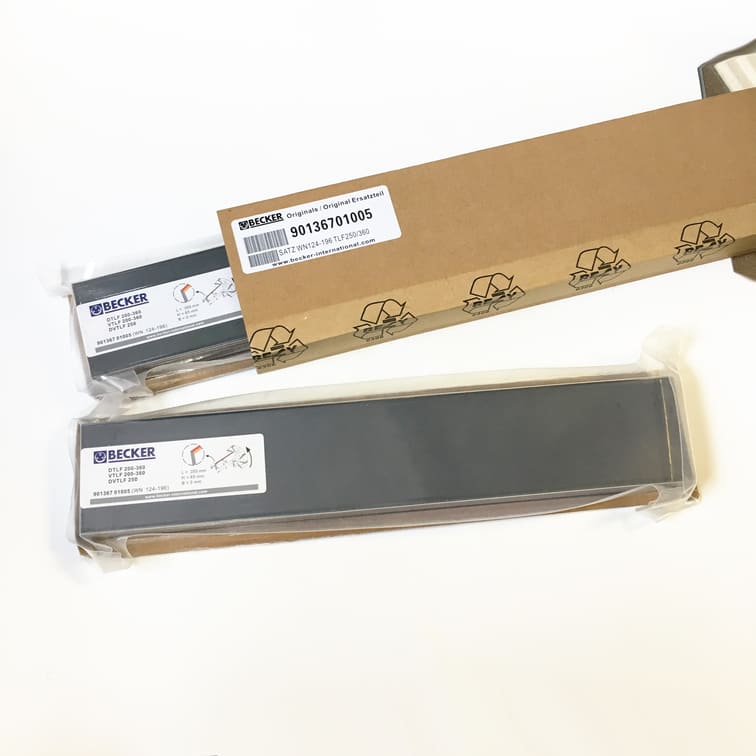
Vacuum Pump Carbon Vanes: The Complete Guide to Selection, Replacement & Maintenance
Carbon vanes are the heart of any dry-running rotary vane vacuum pump — and they’re also the component that wears out fastest. If your pump has lost vacuum pressure, started running louder than usual, or overheats within minutes of operation, the vanes are almost certainly due for replacement.
A set of OEM-quality carbon vanes, properly installed, can restore your pump to factory performance for a fraction of the cost of a new unit. Get the vanes wrong, and you risk scoring the cylinder walls, damaging the rotor, and turning a $200 maintenance job into a $3,000 pump replacement.
This guide covers everything you need to know: what carbon vanes are, how to spot wear before it causes damage, step-by-step replacement instructions for major brands, and how to choose between OEM and aftermarket options without getting burned.
Key Takeaways
– Carbon vanes are sacrificial wear components in dry-running rotary vane pumps — they typically last 3,000 to 10,000 operating hours before replacement
– Becker, Busch, Elmo Rietschle, and ORION each use specific vane dimensions and materials — cross-brand substitution will destroy your pump
– OEM vanes cost more upfront but include precision machining (±0.02 mm tolerance) and smart-fail design features that protect pump internals
– Three-day worldwide shipping from multi-brand specialists eliminates the downtime penalty of ordering from individual manufacturers
– A proper replacement includes cleaning rotor slots with compressed air, verifying bevel orientation, and manual rotation testing before power-on
What Are Carbon Vanes and How Do They Work?
The Role of Carbon Vanes in Rotary Vane Vacuum Pumps
A rotary vane vacuum pump works by spinning an off-center rotor inside a cylindrical housing. Carbon vanes slide freely in slots cut into the rotor — as the rotor turns, centrifugal force pushes the vanes outward against the housing wall, creating expanding and contracting chambers that move air from the inlet to the exhaust.
The vanes are in constant contact with the housing wall. In a dry-running pump (no oil), that contact generates friction and heat. This is where the material science matters: carbon-graphite composite vanes shed a microscopic layer of graphite dust as they run, which coats the pump interior and acts as a solid lubricant. The vanes are designed to wear — it’s the trade-off that makes oil-free operation possible.
When Marcus, a maintenance supervisor at a German packaging plant, noticed his Becker VT4.40 struggling to hold vacuum during the afternoon shift, he pulled the end plate and found the carbon vanes worn to half their original width. “We’d been running 16 hours a day for two years without touching them,” he said. “Another week and the rotor would have started grinding the housing.” His team replaced the set of four vanes in under an hour. The pump was back at full vacuum by the next shift.
Carbon-Graphite vs. Fiber Composite Vanes: Know the Difference
This distinction trips up even experienced technicians. The two vane types are not interchangeable.
| Carbon-Graphite Vanes | Fiber Composite Vanes | |
|---|---|---|
| Used in | Dry-running (oil-free) pumps | Oil-lubricated pumps |
| Material | Carbon-graphite blend, self-lubricating | Carbon fiber or glass fiber in phenolic/epoxy resin |
| Wear pattern | Gradual, sacrificial — graphite dust lubricates pump | Minimal wear — oil provides lubrication |
| Replacement cycle | Every 3,000-10,000 hours | Tens of thousands of hours, often life of pump |
| Surface feel | Soft, slightly powdery | Hard, smooth, rigid |
| Failure mode | Crumbles into fine dust (smart-fail) | Chips, cracks, or delaminates |
Installing hard fiber vanes in a dry-running pump will destroy the housing from friction within hours. Installing soft carbon vanes in an oil-lubricated pump will cause them to disintegrate rapidly in the oil bath. Match the vane type to your pump’s design.
Carbon Vanes by Brand: What Fits What
Every major vacuum pump manufacturer uses proprietary vane dimensions. A Becker vane will not fit a Busch pump, and vice versa. Here’s what you need to know for each of the big four brands.
Becker Carbon Vanes
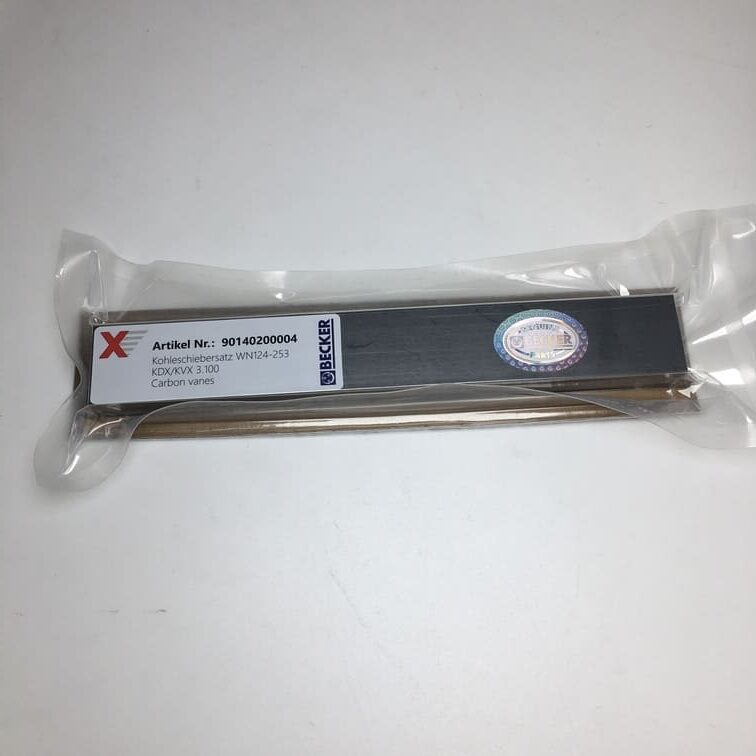
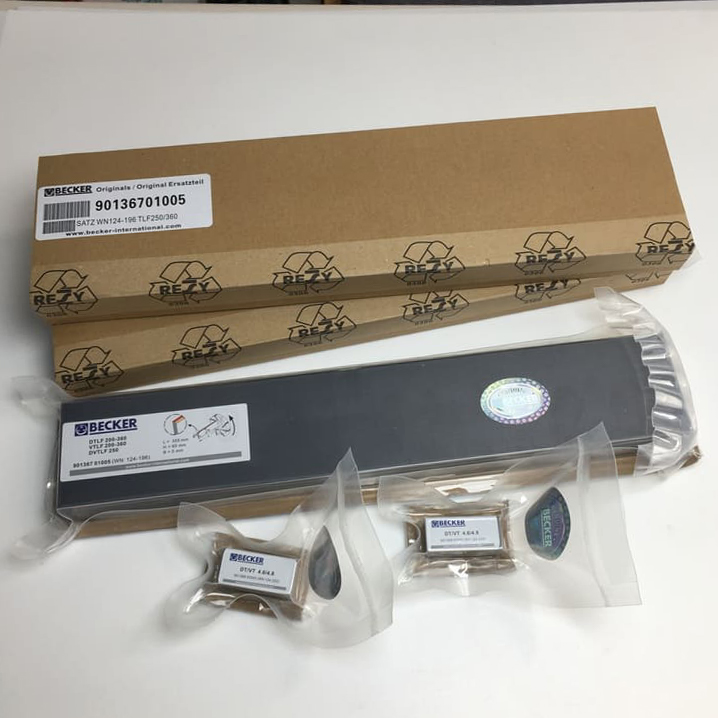
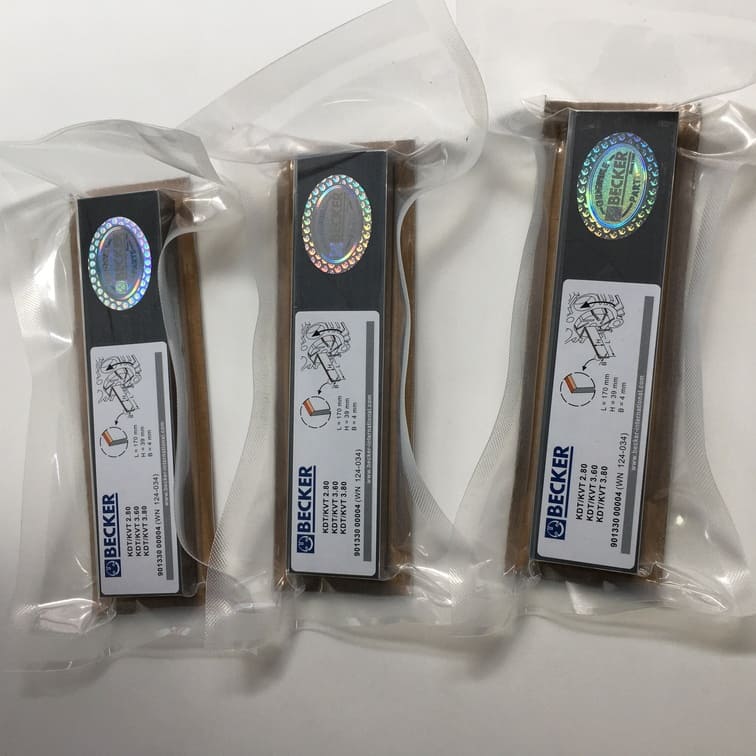
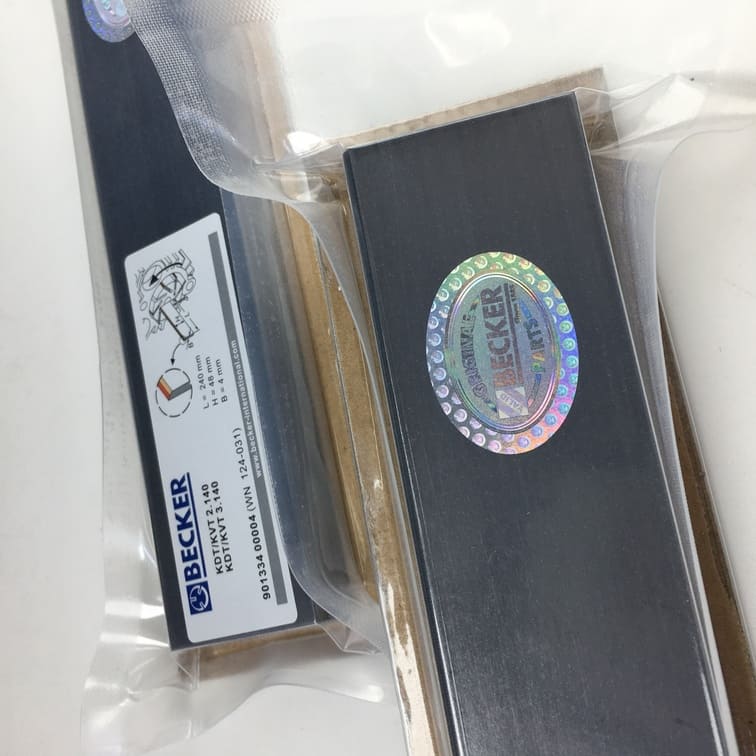
Becker dry-running pumps (VT series, KVT series, SV series) use self-lubricating carbon-graphite vanes. Becker specifies tight dimensional tolerances and their OEM vanes include a “smart-fail” feature — when they eventually wear past minimum spec, they crumble predictably into fine dust rather than cracking into sharp fragments that could score the cylinder.
Common Becker models requiring carbon vanes: VT4.4, VT4.8, VT4.16, VT4.25, VT4.40, KVT3.60, KVT3.80, SV5.690, SV5.790
Inspect Becker carbon vanes every 3,000 operating hours. Replace when vane width drops below 25% of the original dimension.
Busch Carbon Vanes
Busch offers both dry-running (SECO series) and oil-lubricated (R5 series) rotary vane pumps. Only the SECO dry pumps use self-lubricating carbon-graphite vanes. The R5 oil-lubricated series uses fiber composite vanes — do not confuse the two.
Common Busch dry-running models requiring carbon vanes: SECO SV1025C, SECO SV1040C, SECO SV1016C, SECO SD1102, SECO SV200
Busch uses SIGRAFINE-brand carbon materials (EK60 grade) for their OEM vanes, with claimed 3x longer life compared to generic competitor vanes.
Elmo Rietschle Carbon Vanes
Elmo Rietschle (part of the Gardner Denver group) produces both dry and oil-lubricated vacuum pumps. Their V-VTE, V-VTA, and V-VTR dry-running series all use carbon-graphite vanes.
Common Elmo Rietschle dry-running models requiring carbon vanes: V-VTE 3, V-VTE 6, V-VTE 10, V-VTA 113, V-VTA 116, V-VTR 140, V-VTR 150
Thomas/Gardner Denver recommends inspecting carbon vanes at 4,000-hour intervals and replacing when vane height falls below approximately 10 mm for the VTE series.
ORION Carbon Vanes
ORION dry-running rotary vane pumps are widely used in packaging, printing, and medical equipment applications. Their carbon vanes are manufactured to match OEM specifications for the ORION K series and S series.
Common ORION models requiring carbon vanes: ORION K06, ORION K08, ORION K16, ORION S150, ORION S250, ORION S350
Need carbon vanes for a specific model? Browse our complete carbon vane catalog →
Signs Your Carbon Vanes Need Replacement
Catching worn vanes early prevents rotor and housing damage. Here are the symptoms to watch for.
Performance Symptoms
| Symptom | What’s Happening | Urgency |
|---|---|---|
| Reduced vacuum pressure | Vanes worn too thin to maintain seal against housing wall | Replace within 1-2 weeks |
| Increased operating noise | Worn vanes chattering or rattling in rotor slots | Inspect immediately |
| Pump overheating | Excess friction from uneven vane contact | Stop pump, inspect same day |
| Visible carbon dust in exhaust | Accelerated vane wear, possibly from contaminated intake air | Inspect, check inlet filters |
| Intermittent vacuum loss | Vanes sticking in slots due to uneven wear or debris | Clean and inspect |
Visual Inspection Checklist
Pull the end plate and inspect the vanes directly. Here’s what to look for:
- Width below minimum — most manufacturers specify a minimum vane width; if your vanes look noticeably thinner than a new set, they’re due
- Uneven wear — vanes should wear evenly along their length; wear concentrated on one edge indicates misalignment or bevel installation error
- Chipping or cracking — any visible damage means immediate replacement, no exceptions
- Carbon dust buildup in rotor slots — excessive dust compacts and prevents new vanes from sliding freely; clean thoroughly
- Discoloration or glazing — a shiny, glazed surface on the vane edge indicates overheating; check operating temperature and airflow
How to Replace Carbon Vanes: Step-by-Step
When Sarah, a field service tech, got called to a printing plant where a Busch SECO had lost vacuum mid-run, she had the pump apart, cleaned, and rebuilt with fresh carbon vanes in 42 minutes. Her process is what every replacement should look like.
Step-by-Step Replacement Guide
Step 1: Safety and preparation. Disconnect power completely — lockout/tagout. Let the pump cool. For dry-running pumps, no oil to drain, but wear gloves to avoid transferring skin oils to the new vanes. Work on a clean bench.
Step 2: Remove the end plate. Take off any plastic fan covers or guards first. Then remove the end plate bolts — typically 6-8 hex-head screws around the perimeter. Some models require gentle tapping with a rubber mallet to free the plate. Do not pry with a screwdriver — you will score the mating surface.
Step 3: Remove old vanes. Slide each old vane out of its rotor slot by hand. Note the bevel/chamfer orientation before removal — take a photo with your phone. Old vanes may be thin, fragile, or crumbly. Do not force stuck vanes; gently work them free.
Step 4: Clean everything. This is the step most people rush, and it is the most common cause of premature vane failure. Use compressed air to blow carbon dust out of every rotor slot, then wipe the housing interior with a lint-free cloth and solvent (brake cleaner works well). A maroon Scotch-Brite pad removes stubborn carbon deposits from the cylinder wall.
Inspect the housing for scoring or “washboarding” — if the wall is damaged, new vanes won’t seal properly.
Step 5: Install new vanes. Insert each new vane with the beveled edge facing the correct direction (match your reference photo). The vane must slide freely in its slot with no binding. If a vane is slightly long, sand the end carefully — but verify with your supplier that you have the correct model first.
Step 6: Reassemble. Replace the end plate, aligning any guide pins. Tighten bolts in a cross-pattern to the manufacturer’s torque specification. Replace fan covers and guards.
Step 7: Test. Before connecting power, rotate the fan or shaft by hand. You should feel smooth, uniform resistance and hear the soft sound of vanes sliding. Connect power, run briefly, and listen for abnormal noise. Check vacuum pressure with a gauge.
Common Installation Mistakes
- Installing vanes upside down. The bevel must match the angle of the housing wall. A backwards vane will stick instantly and shatter. Always photograph the original orientation.
- Skipping the cleaning step. Carbon dust packed into rotor slots prevents new vanes from moving freely. Compressed air is the minimum; solvent cleaning is better.
- Using the wrong vane material. Installing fiber vanes in a dry pump, or carbon vanes in an oil pump, will destroy the pump.
- Not rotating by hand before power-on. A stuck vane that gets hit with 3,000 RPM will shatter and send debris through the pump.
Not sure which vanes fit your pump? Send us your model number and we’ll confirm compatibility →
OEM vs. Aftermarket Carbon Vanes
The choice between OEM and aftermarket carbon vanes comes down to risk tolerance and application criticality.
What You’re Actually Paying For
OEM vanes from Becker, Busch, and Elmo Rietschle cost more — sometimes significantly more — because they include:
– Material verification: Documented carbon-graphite composition with specified impregnation resin type
– Dimensional precision: Tolerances of ±0.02 mm, critical for proper vane movement in rotor slots
– Smart-fail design: Engineered failure mode that crumbles predictably rather than shattering
– Warranty protection: Using OEM vanes preserves your pump warranty
High-quality aftermarket vanes can match OEM specifications at 30-50% lower cost. The key is vetting your supplier.
Quality Indicators to Check
| Factor | What to Verify |
|---|---|
| Dimensional tolerance | Must be ±0.02 mm — request inspection reports |
| Surface roughness | ≤ 0.8 µm Ra |
| Impregnation type | Phenolic, epoxy, or metal-filled resin matched to your operating temperature |
| Material certificates | Supplier should provide hardness and flexural strength test values |
| Sample testing | Always test a sample set for 100+ hours before committing to bulk |
The plant manager at a Chinese packaging facility learned this the hard way. He ordered 50 sets of “Becker-compatible” carbon vanes at $12 per set. Within three months, the vanes wore unevenly, left carbon deposits that jammed rotors, and two pumps needed cylinder replacement.
The $600 he saved cost him $4,200 in repairs and 11 days of downtime. He now buys OEM-spec vanes from a specialist supplier with QC documentation — and hasn’t had a vane-related failure in 18 months.
Carbon Vane Maintenance and Lifespan
How Long Do Carbon Vanes Last?
Under normal operating conditions (clean air intake, ambient temperature below 40°C, continuous duty cycle), expect:
| Pump Brand | Typical Carbon Vane Life | Inspection Interval |
|---|---|---|
| Becker dry-running | 8,000-15,000 hours | Every 3,000 hours |
| Busch SECO series | 10,000-20,000 hours | Every 4,000 hours |
| Elmo Rietschle V-VTE | 6,000-12,000 hours | Every 4,000 hours |
| ORION dry-running | 5,000-10,000 hours | Every 3,000 hours |
Actual lifespan depends heavily on operating conditions. High ambient temperature, contaminated intake air, frequent start/stop cycling, and overspeed operation all reduce vane life significantly — in some cases by 50% or more.
Maintenance Best Practices
- Check inlet filters monthly. The number one cause of premature carbon vane wear is particulate contamination through dirty or missing intake filters. Replace filters on schedule.
- Monitor operating temperature. Sustained temperatures above 40°C accelerate carbon vane wear dramatically. Verify adequate airflow around the pump.
- Keep a vane inspection log. Record vane width measurements at each inspection. Tracking the wear rate lets you schedule replacements predictively rather than reactively.
- Stock spare vanes. The most common downtime scenario is a pump going down while replacement vanes are in transit. Multi-brand suppliers with 3-day worldwide shipping eliminate this gap.
- Avoid running the pump in reverse. Reversed rotation can cause vanes to catch and shatter. Verify motor direction after any electrical work.
Why Multi-Brand Sourcing Matters
Most manufacturing facilities run vacuum pumps from multiple brands — a Becker on the packaging line, a Busch on the CNC hold-down, an ORION on the printing press. Ordering replacement vanes from each manufacturer individually means managing multiple supplier relationships, paying separate shipping on each order, and juggling different lead times.
A specialist supplier that stocks carbon vanes for all four major brands consolidates your ordering into a single shipment with a single invoice. For facilities in regions with limited local distribution, this is the difference between a pump being down for three days versus three weeks.
One international buyer who operates six packaging plants across Southeast Asia switched to consolidated vane ordering in 2025. His maintenance teams now keep a standardized spare-parts shelf with vanes for every pump model in the fleet. “Before, each plant was ordering from whoever was available locally — different quality, different prices, different lead times,” he said. “Now we order quarterly, one shipment per region, everything arrives within the same week, and our per-unit cost dropped 22%.”
Ready to simplify your vacuum pump maintenance? Contact us for a consolidated spare-parts quote →
Frequently Asked Questions
Can I use the same carbon vanes in any brand of vacuum pump?
No. Each brand uses specific vane dimensions (length, width, thickness) and material grades. A Becker vane will not fit a Busch pump. Always match the vane to your exact pump model.
How do I know if my pump uses carbon vanes or fiber vanes?
Check your pump manual. If your pump is a dry-running (oil-free) model, it uses carbon-graphite vanes. If it requires oil, it uses fiber composite vanes. When in doubt, pull an old vane — carbon vanes feel soft and slightly powdery; fiber vanes feel hard and rigid.
How long does it take to replace carbon vanes?
For a trained technician with the correct replacement vanes on hand, 30-60 minutes is typical for most models. The cleaning step takes as long as the actual vane swap.
What happens if I don’t replace worn carbon vanes?
Worn vanes lose contact with the housing wall, reducing vacuum pressure. Eventually, the rotor can contact the housing directly, scoring the cylinder wall and requiring a full pump rebuild or replacement — far more expensive than a vane set.
Conclusion
Carbon vanes are the single most important maintenance item on any dry-running rotary vane vacuum pump. They are designed to wear, and replacing them on schedule is far cheaper than the pump damage that worn-out vanes cause.
The key decisions are straightforward: match the vane to your pump model and brand, choose a quality level appropriate to your application (OEM for critical pumps, verified aftermarket for less demanding ones), and keep spare sets on hand so you are never waiting on a shipment while production is down.
For Becker, Busch, Elmo Rietschle, and ORION pump operators, a multi-brand supplier consolidates procurement and eliminates the lead-time lottery of ordering from individual manufacturers. Three-day worldwide shipping and OEM-compatible quality turn vane replacement from a crisis into a routine maintenance task.
Need carbon vanes for your vacuum pump? Browse our full range by brand → or send us your pump model for a quick compatibility check →